
Hyperspectral Imaging
Reflectance imaging spectroscopy (IS) allows recording the radiation reflected from the surface of an object and capturing the reflectance spectrum for each pixel in the image. It is an imaging technique that sequentially captures hundreds of reflectance frames over narrow, nearly contiguous spectral bands. When the spectral resolution is only a few nm, it is possible to refer to IS as hyperspectral imaging (HSI).
HSI represents a very powerful spectroscopic technique where images are taken over a wide wavelength range and can be used for high-quality documentation of the work. A hyperspectral camera can simultaneously acquire an image and, for each pixel, the relative spectrum. This generates what is commonly called a 'data cube' by combining imaging and spectroscopy.
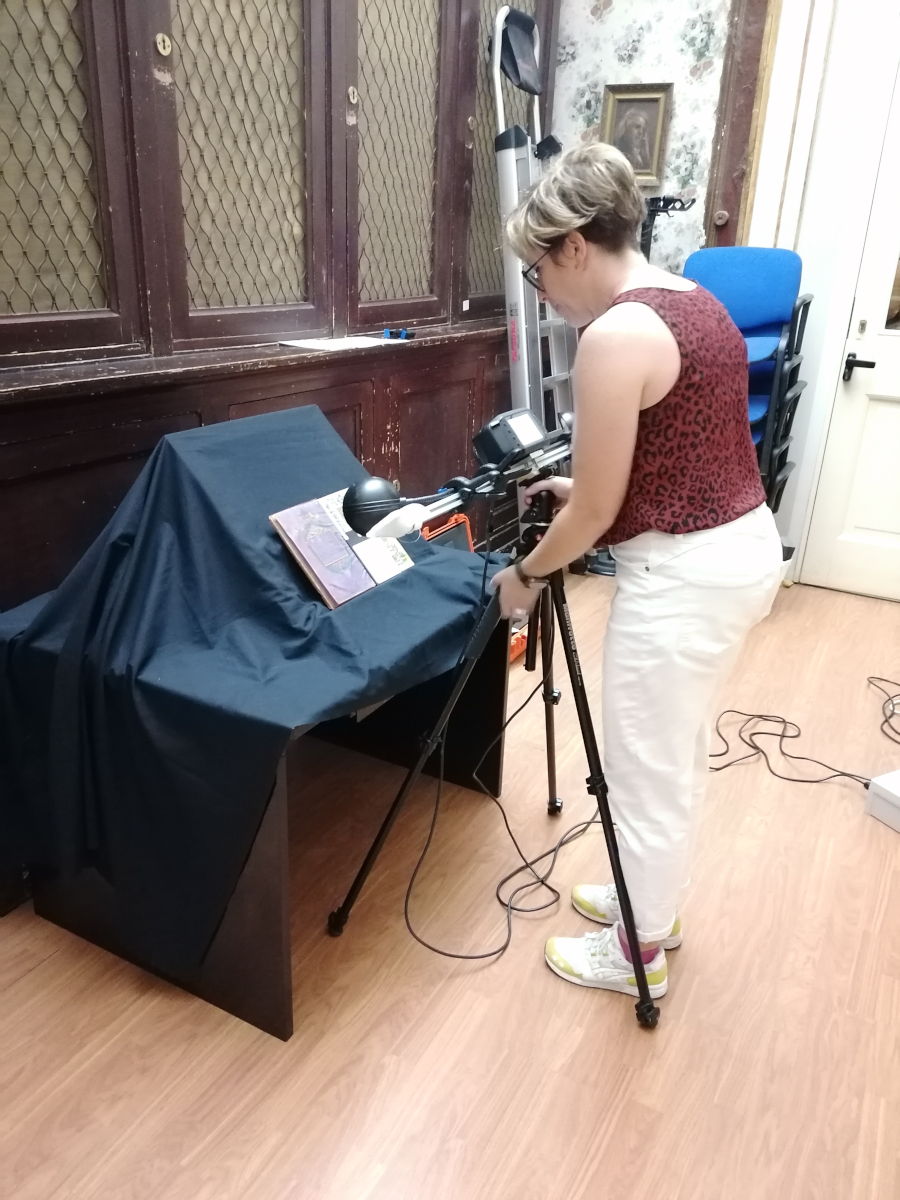
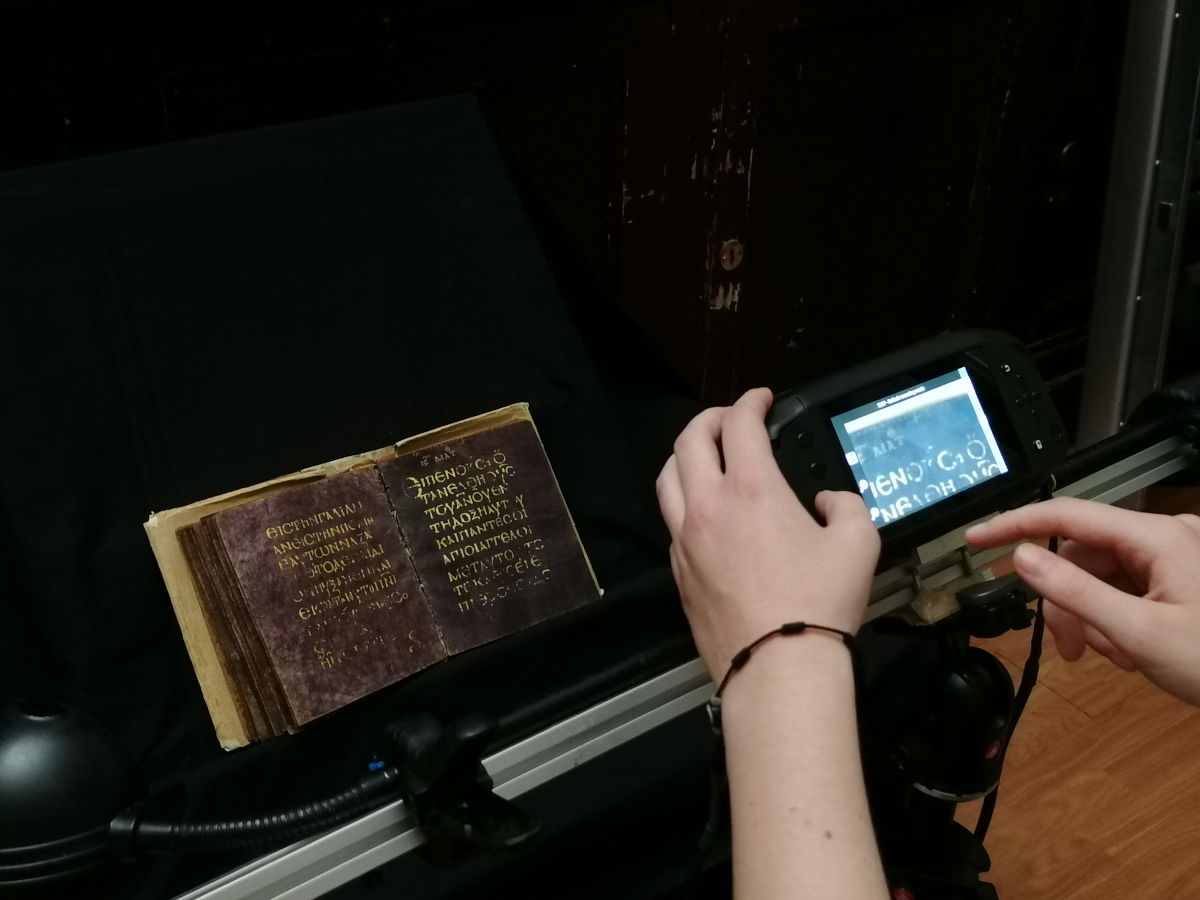
The latest frontier of hyperspectral devices relies in the availability of a wide range of compact, portable and user-friendly devices. An IQ-Specim hyperspectral camera by SPECIM, Spectral Imaging Ltd. (Oulu, Finland) was used in the present study. The camera operates by acquiring 204 bands in the 400-1000nm range, with a final spectral resolution of about 7 nm. The novelty of the device relies in its reduced dimensions (207 x 91 x 74 mm) and weight (1.3 Kg), and a user-friendly interface, which makes this camera much more portable, manageable and affordable than conventional hyperspectral instrumentation. The optical module of the camera allows obtaining images of different size areas, by varying the working distance from short-distance (tens of cm) to long distances (tens of meters) with different spatial resolutions.
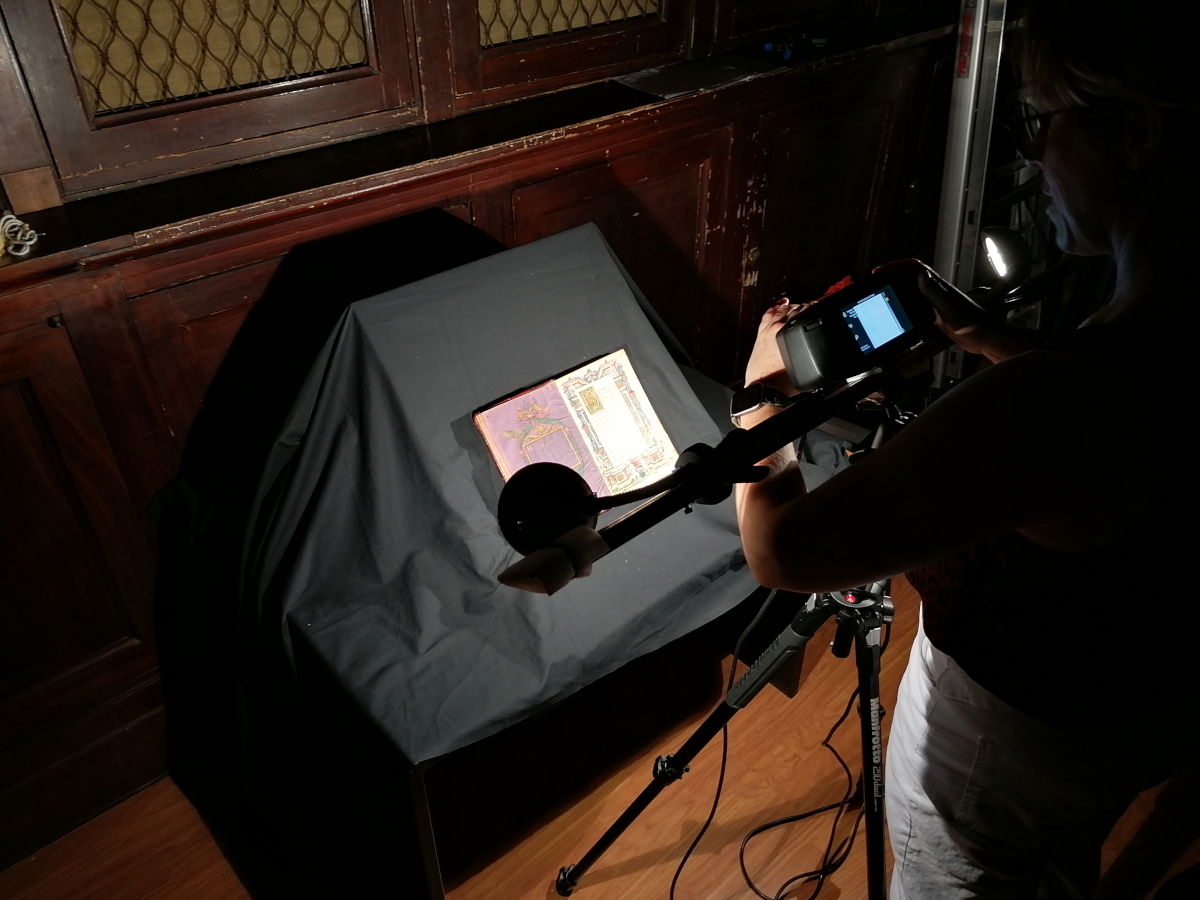
The camera operates in the 400-1000 nm spectral range (using a silicon CMOS sensor) with a resolution of 7 nm and records 204 spectral bands on 512 x 512 pixels. The recommended sources for Specim IQ are halogen sources that allow covering the entire sensitivity range of the camera (www.specim.fi). During the present study, two 12 V, 50 W halogen lamps from Osram were used. The lamps were mounted symmetrically at 45° to the normal direction of the surface to be acquired in order to illuminate it uniformly. These low-intensity sources were selected to ensure minimal impact on a highly photosensitive material such as parchment and the amount of radiation sent onto the code during filming was then measured using a data logger. The values were approximately 2000 lux (lm/m2) in the visible and 45 mW/m2 in the UVa and a UVa/visible ratio of 22.5 μW/lm, the latter being within the maximum acceptable UVa radiation dose.
The device is based on the use of a next-generation imaging spectrograph with a diffractive transmissive component. Acquisition over the investigated area is performed in push-broom, a line-scanning mode working thanks to an integrated scanner. The camera is also equipped with a user interface system to allow real-time control over data acquisition, processing and visualization.
White target calibration was performed at the beginning and end of the measurement session, using the certified Spectralon® 99% diffuse reflectance white reference supplied with the camera. The white target is usually framed within the scene being investigated. However, the system also supports an operating mode to acquire the white reference separately (www.specim.fi).
The data were processed using the Specim IQ Studio PC software and a mapping of the different materials was performed using the Spectral Angle Mapper (SAM) algorithm. This method evaluates the similarity between a reference spectrum and the spectra associated with the pixels of the acquired data. All those pixels with the same spectral behaviors can be then visualized in false-colour images and allowed mapping the inhomogeneities of the parchment, as well as the distribution of pigments and inks used.
 |
 |
 |
|
|
Hyperspectral imaging setup at the Biblioteca Nazionale Vittorio Emanuele III of Naples. |
|
References
- Cucci, C., Casini, A., Stefani, L., Picollo, M. and Jussila, J., 2017, July. Bridging research with innovative products: a compact hyperspectral camera for investigating artworks: a feasibility study. In Optics for Arts, Architecture, and Archaeology VI (Vol. 10331, pp. 17-29). SPIE.
- Cucci, C. and Casini, A., 2019. Hyperspectral imaging for artworks investigation. In Data handling in science and technology (Vol. 32, pp. 583-604). Elsevier.
- Picollo, M., Bacci, M., Casini, A., Lotti, F., Poggesi, M. and Stefani, L., 2007. Hyperspectral image spectroscopy: a 2D approach to the investigation of polychrome surfaces. Proceedings of Conservation Science, pp.10-11.
- Picollo, M., Cucci, C., Casini, A. and Stefani, L., 2020. Hyper-spectral imaging technique in the cultural heritage field: New possible scenarios. Sensors, 20(10), p.2843.
- Picollo, M., Casini, A., Cucci, C., Stefani, L., Jiménez-Garnica, R. and Fuster-López, L., 2020, November. Documentation and analysis of some Picasso’s paintings by using hyperspectral imaging technique to support their conservation and stylistic matters. In IOP Conference Series: Materials Science and Engineering (Vol. 949, No. 1, p. 012023). IOP Publishing.